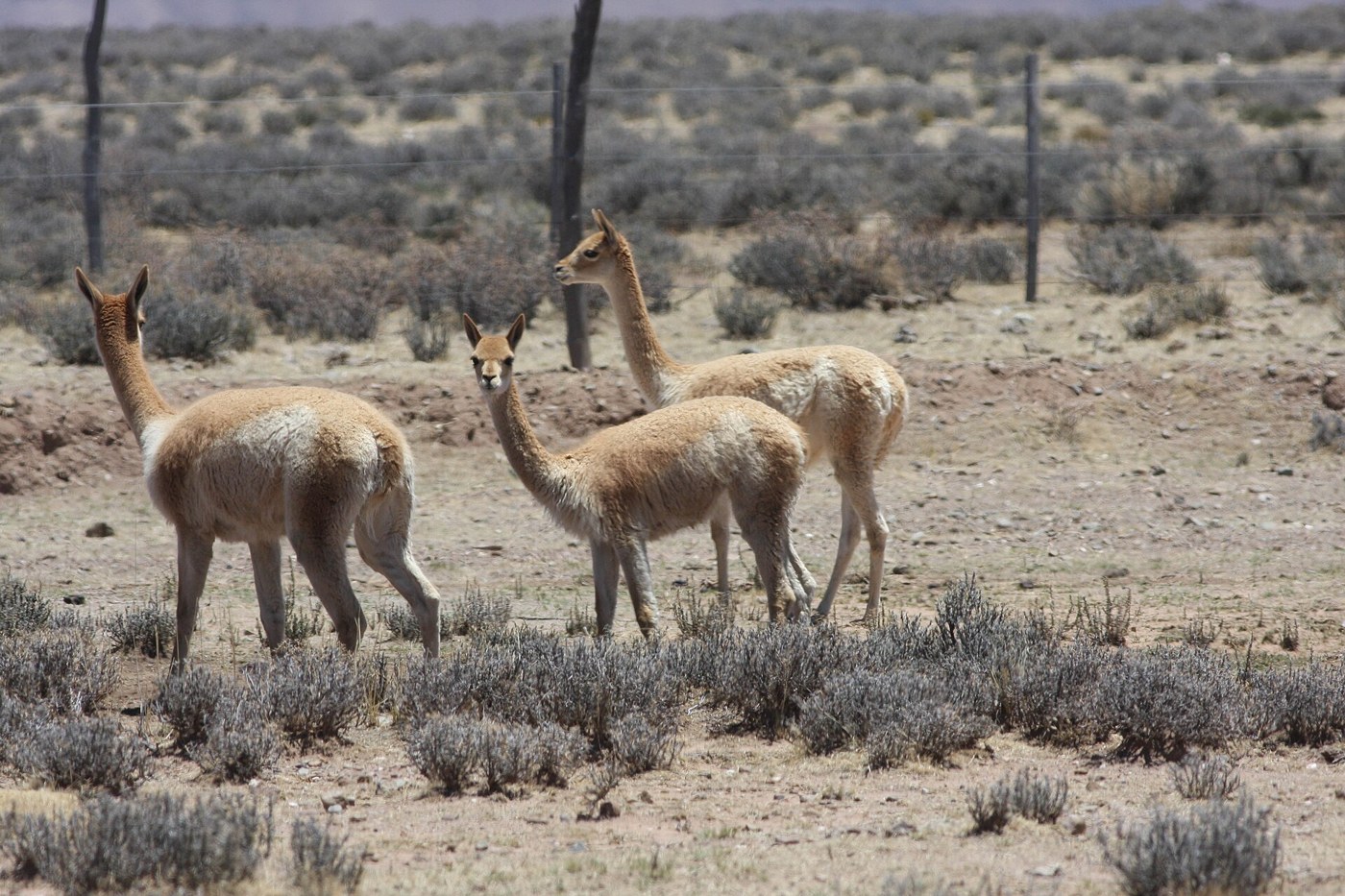

In the open spaces of the Puna, a vicuña can appear small within an enormous landscape. That proportion is part of the observation: the animal is using its territory, not posing beside the road. The photograph accompanying this article shows vicuñas around Laguna de los Pozuelos in Jujuy. It does not guarantee an encounter on every visit, but it illustrates why patient watching matters before deciding that a plain is empty.
Identification and behavior
The vicuña is a wild camelid of high Andean environments. Its slender body, long neck, narrow ears, and pale brown coloring contrast with whitish areas. It is herbivorous and feeds on highland vegetation. These features can guide identification, although a distant animal should not be labeled solely from its color: an incomplete observation can honestly remain simply a “camelid.”
The distinction from a llama also matters for visitor behavior. Domestic animals near a settlement do not make vicuñas livestock that visitors may approach or feed. Look at the whole scene rather than assuming every animal without a human attendant belongs to the same species or situation. Binoculars can preserve visible detail without reducing the physical distance.
Groups and their movements provide subjects for observation. Are the animals grazing, standing still, or moving? Do they remain together or spread out? Recording these actions is more reliable than assigning motives such as curiosity or trust. Descriptions of the species' social organization include family groups and other groupings; a single view does not always reveal each individual's role.
Distance is part of the visit
If your arrival changes the group's behavior, do not turn that response into an opportunity to photograph running animals. Remain on the permitted route, reduce movement, and follow the area's instructions. Do not walk after them to recover a lost composition. Observation should end before the photographic objective requires changing the animal's behavior.
Vicuña fiber also connects conservation with Andean communities. Authorized management involving live shearing exists, including experiences described by official tourism information for Laguna Blanca in Catamarca. That context does not authorize visitors to touch, gather, or pursue animals independently. To learn about a management activity, establish who organizes it, what participation is allowed, and which rules currently apply.
A useful record can include location, date, an approximate number, and observed behavior, without inventing precision when animals are dispersed. Avoid publishing directions that encourage leaving established routes to approach a group. The strongest image does not have to fill the frame with one animal: retaining some grassland and horizon also explains the environment on which the vicuña depends.