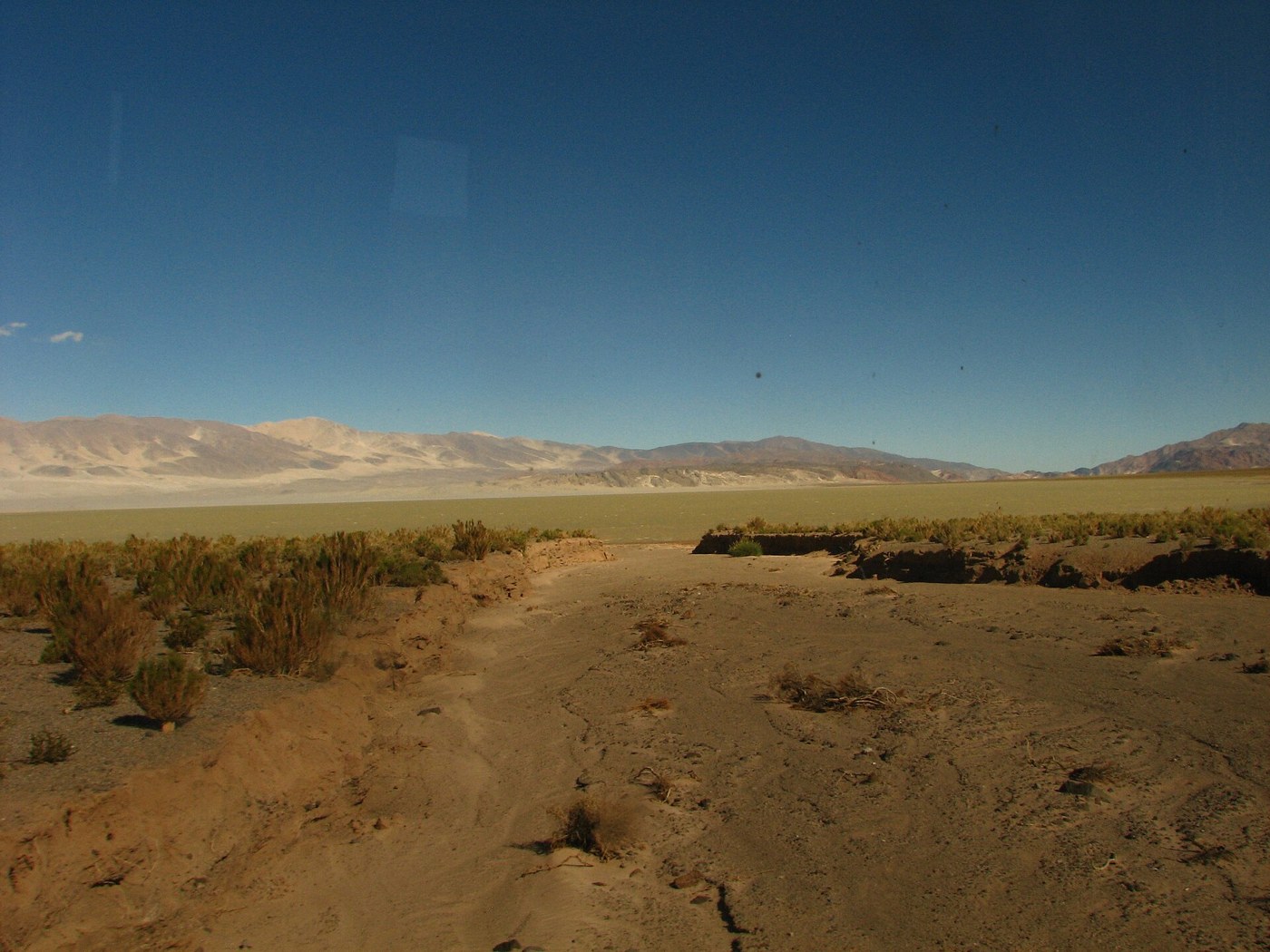

Laguna Blanca is difficult to understand if you imagine a lake separated from the people around it. In this part of Catamarca, the landscape includes water, dry environments, settlements, and productive activities. The designation biosphere reserve does not mean the entire territory is an uninhabited sanctuary. An attentive visit can connect these dimensions instead of dividing a nature excursion from a cultural excursion as though they never occupied the same space or influenced one another.
Distinguishing environments
Official descriptions present a saline lake surrounded by highland environments, with wet meadows and grasslands among dry areas. To observe that variety, start with the distribution of green vegetation. Does it form a strip, a patch, or a continuous surface? The question helps distinguish environments within a view that may initially appear uniform. A shoreline, a wet meadow, and a dry slope do not offer identical conditions, even when all three fit into the same panoramic photograph.
A second reading looks for connections. From permitted locations, notice relationships between a settlement, a road, and vegetated areas. You do not need to infer the function of every plot yourself: a local conversation or museum explanation may clarify it. A productive landscape requires knowledge of resources, seasons, and management. Recognizing that work avoids describing rural life as spontaneous, unchanging, or separate from the present decisions of its inhabitants. What seems quiet from a distance may involve considerable planning and knowledge.
The museum and its territory
The Museo Integral de Laguna Blanca, associated with the Universidad Nacional de Catamarca, proposes a territorial approach of this kind. Its scope includes communities, memories, and natural and cultural heritage beyond its interpretation rooms. Find out which components can be visited during your trip and how those visits are arranged. The term integral museum does not promise that every associated site is freely accessible or that visitors can explore the territory without making appropriate arrangements first.
During an archaeological explanation, pay attention to distinctions between evidence, interpretation, and memory. A structure allows certain questions to be asked; a community account may introduce others. A date does not resolve everything, and different histories need not fit into one short sentence. Asking who studied a place, who cares for it, and how it is presented today produces a richer visit than looking only for the oldest object. Present inhabitants are not illustrations of a distant past.
Choosing a focus for the visit
Wildlife observation needs context too. Tourism sources mention vicuñas and waterbirds, but that does not guarantee close encounters or a particular scene. When arranging an outing, explain whether your main interest is the wetland, the productive landscape, or cultural interpretation. An itinerary designed to move between stops may allow little time for watching birds. Avoid approaching animals to force a photograph, and do not confuse specific community activities with performances available for visitors every day of the year.
Prepare by choosing two connected questions: how does the presence of water vary across environments, and how is life organized around them? Then add a third about who interprets that territory. Leave room to listen and adjust your expectations. Laguna Blanca offers more when approached as a place with current relationships, knowledge, and decisions of its own, rather than an empty backdrop waiting for a traveler to arrive and give it a story.